 Follow ASTCT®
Post-transplant cyclophosphamide (PTCy) has transformed allogeneic hematopoietic cell transplantation (HCT) by enabling the use of mismatched and haploidentical donors, making transplantation accessible to more patients.
During the 2026 Tandem Meetings | Transplantation & Cellular Therapy Meetings of ASTCT® and CIBMTR®, the Feb. 5 concurrent session Choosing an Allogeneic Donor Has Never Been This Easy – Right?! highlighted guidelines, global differences and unresolved questions related to donor selection.

NMDP/CIBMTR donor selection guidelines
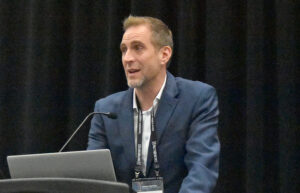
Stephen Spellman, MBS, vice president of research at National Marrow Donor Program (NMDP) and senior scientific director at the Center for International Blood and Marrow Transplant Research (CIBMTR), reviewed the updated NMDP-CIBMTR Allogeneic Hematopoietic Donor Selection Guidelines.
He noted that the increased use of PTCy has driven a growth in mismatch, haploidentical and mismatched unrelated donor transplants — factors that greatly shaped the need for new guidelines.
In the calcium urine inhibitor setting, the recommendations remain largely unchanged, with human leukocyte antigen (HLA) loci A, B and DR matching remaining critical for donor selection. However, Spellman said, we are still learning in the PTCy and mismatched unrelated donor (MMUD) setting.
New data is changing how donor search strategies are approached. Searching for all donor types should be performed concurrently and with search prognosis tools to identify patients who may benefit from early consideration of alternative donor sources.
“Understanding your likelihood of having a well-matched donor on the registry should help guide your strategy. If you don’t have a matched sibling donor in the family, being able to pivot appropriately to the likely alternative source would be beneficial,” Spellman said.
For secondary characteristics, donors aged 30 years or younger should be prioritized to maximize overall survival. Additionally, recommendations state that ABO blood matching may reduce HCT transfusion burden but doesn’t significantly impact overall survival, and that major ABO mismatches should be avoided in haploidentical transplants and when using bone marrow grafts. Finally, patient-donor weight differences should be avoided in bone marrow HCT.
EBMT perspective on donor selection
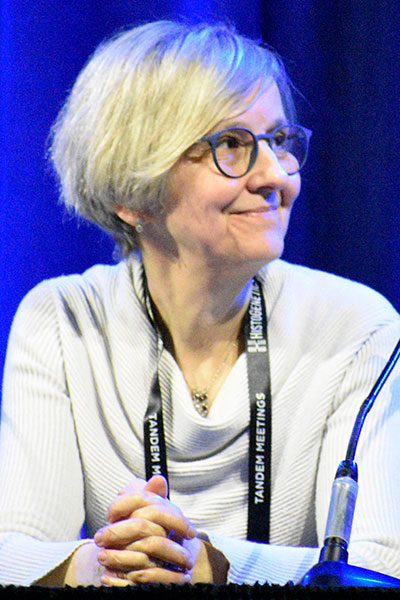
Katharina Fleischhauer, MD, director of the Institute for Experimental Cellular Therapy at the University Hospital Essen, Germany, compared the European Society for Blood and Marrow Transplantation (EBMT) and NMDP guidelines.
Dr. Fleischhauer said the most significant difference is that access to transplants is a concern in the United States (U.S.), largely due to the greater genetic heterogeneity in the population.
In Europe, many centers continue to use anti-thymocyte globulin (ATG), although it is less frequently used in the U.S. This difference is due to varying trial results. A European landmark trial found that ATG reduces the risk of graft-versus-host disease (GVHD). However, this was not observed in a U.S. trial. In fact, there was a decrease in overall survival.
Regarding the role of HLA, a U.S. study found similar overall survival rates for patients with 7/8 and 8/8 matches. This is not consistent with the findings in the EBMT cohort, where they observed a significant disadvantage for a single HLA mismatch. One major difference is that the EBMT study included any hematologic malignancy, whereas the U.S. study only focused on acute myeloid leukemia (AML), acute lymphoblastic leukemia (ALL) and myelodysplastic syndromes (MDS).
“We are now joining forces and trying to better understand what might really drive these differences in these data sets,” said Dr. Fleischhauer.
From the EBMT perspective, unanswered questions include the effects of PTCy versus ATG, the role of HLA and donor age under PTCy and whether certain mismatched combinations may reduce relapse.

Unanswered questions, future directions
Antonio Jimenez Jimenez, MD, associate clinical professor at the University of Miami, discussed some unanswered questions in donor selection in the PTCy era.
The first question is: How low can we safely go in HLA matching with mismatched unrelated donors (MMUD) and PTCy? The introduction of PTCy has changed the historical mismatch penalty. Most current MMUD data sets now include 6/8 and 7/8 donors, with data indicating similar outcomes.
The second question is: Do specific HLA mismatches matter in MMUD and PTCy, or could some be beneficial? Study results suggest that locus-specific MMUD selection in PTCy remains controversial and not ready for a prescriptive algorithm.
The third question is: How should donor-specific antibodies (DSA) be operationalized in donor selection? These are a recognized risk factor for graft failure and limit donor availability. Dr. Jimenez Jimenez provided two strategies — immunodepletion and donor selection — to mitigate the risks from DSA. However, both strategies have disadvantages, and work remains to be done in this area.
The final question that Dr. Jimenez Jimenez posed is: Does donor age matter more than donor type in high-risk AML and MDs? Recent data suggest that younger, unrelated donors may confer a survival advantage compared to older siblings. Dr. Jimenez Jimenez said that a practical way to navigate these trade-offs is to consider urgency, danger of relapse, tolerance for GVHD and the planned GVHD prophylaxis approach on a case-by-case basis.
Watch 2026 Tandem Meetings sessions on demand

If you missed a session or wish to review a session from the 2026 Tandem Meetings, you can access on-demand recordings on the Tandem Meetings website. Registered participants have digital access to scientific plenary and concurrent sessions, oral abstract sessions, honorific lectures, symposia and educational tracks.