 Follow ASTCT®


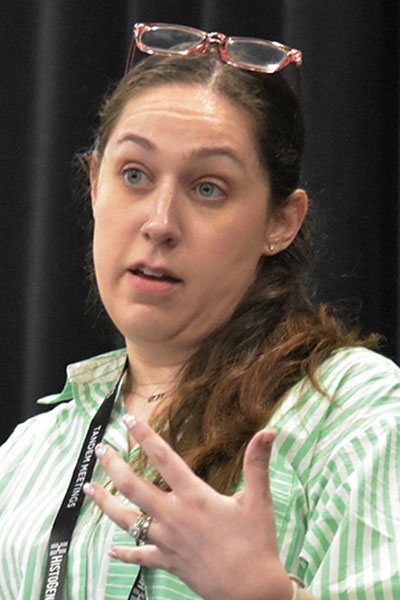
Two social workers with extensive experience working with transplant patients and their families urged nurses to tap their intuition, normalize conversations with patients about barriers to care and refer to social workers when needed to optimize care for vulnerable cell therapy patients. This was some of the key advice shared in the Feb. 7 Nursing Track session Addressing Social Determinants of Health to Improve Access to Cell Therapy at the 2026 Tandem Meetings | Transplantation & Cellular Therapy Meetings of ASTCT® and CIBMTR®.
The entire session is available to in-person attendees and to those with registered digital access for on-demand viewing via the online program.
Why SDOH matters
Social determinants of health (SDOH) is a term that encompasses external conditions — including public policies, environment, economic conditions, ethnic demographics, complications with insurance, food insecurity, housing status, literacy, language barriers and more — that significantly affect a patient’s health, quality of life and ability to access care.
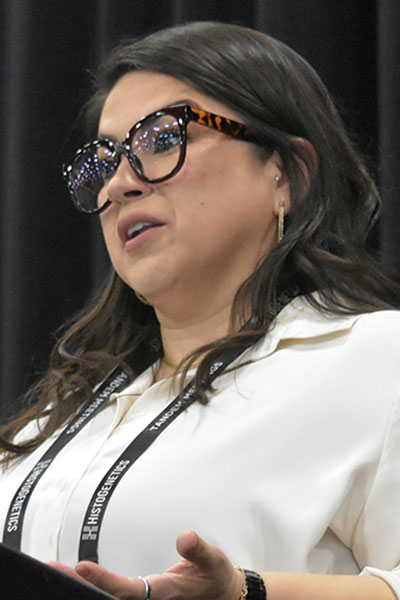
In clinical settings, SDOH can contribute to patients being designated as “nonadherent,” said Jennifer Reyes, MSW, LSCW, a clinical social worker in the transplantation and cellular therapy team at Children’s Hospital Los Angeles.
If a patient is labeled as nonadherent because, for example, they frequently miss or arrive late to appointments, or have poor treatment follow-up, this might indicate that they or their caregiver are experiencing an SDOH issue.
Around 50% to 80% of variations in health outcomes stem from SDOH, compared with 20% due to clinical care gaps or variations. “Social instability places patients at higher risk of poor survivorship outcomes,” Reyes said, adding that at least one adverse SDOH factor is reported by approximately 59% of adults, with more SDOH issues reported by those with chronic diseases.
The role of nurses
Because nurses are at the frontlines of patient care and engagement, they can help detect and reframe the stigma of nonadherent labels by identifying possible SDOH issues, said Jessie Russell, LMSW, an inpatient social worker at the University of Kansas Medical Center.
This is particularly true for nurses working in the field of cell therapy, with its inherent structure of complex medication and supportive care requirements. Nurses are often the first and most extensive point of contact with patients and caregivers, which can lead to a reliable sense of intuition about situations affecting patients and caregivers in and outside the clinical setting.
“We ask a lot, not only of our patients but also of caregivers. Gearing up to get [to cell therapy] is a big undertaking,” Russell said.
When nurses do identify early warning signs of SDOH challenges, they should document them, talk with patients or caregivers, advocate for patient needs and foster discussion within multidisciplinary interprofessional teams.
Reyes noted that it is also essential to listen to patients to understand SDOH that might be affecting them. She gave an example of a mother who seemed to disengage from her child’s treatment and hospitalization post-transplant, making fewer and shorter visits to her child in the hospital. But after talking with the mother, it became apparent that the mother was making a conscious decision; knowing her child in the hospital was safe and past immediate danger, the mother needed to prioritize essentials outside the hospital such as catching up on months of sleepless nights, arranging caregivers for her other child and recovering lost income to pay her family’s rent.
“So even post-cell-therapy, nurses can assess for barriers, caregiver capacity and understanding,” Reyes said, noting this can be done through casual talk. “Those conversations start to snowball and you get to know your patients. It doesn’t feel invasive when you are just wanting to get to know who they are.”
In some cases, early identification can facilitate timely referral/escalation to the social work team, which can work with patients and caregivers to navigate solutions that can keep treatments on track.
Practical tools
Reyes and Russell discussed practical steps that nurses can take to address SDOH, including normalizing conversation around these barriers, developing competence with non-judgmental trauma-informed language, tailoring education and knowing when and how to involve social workers.
They shared checklist handouts (available through the online program) and discussed system-level changes, such as standardizing SDOH screenings, early referral models, clear pathways for escalating patients/caregivers for social work and incorporation of SDOH into Medicaid.
Both Reyes and Russell provided examples of regular inter-team meetings and communication to pool perspectives and advance patient care.
“It does become a lot of people involved and a lot of collaboration, but I think that is what makes it good,” Russell said. “We’re all getting different perspectives, but we’re still having a central place to communicate about the things that are coming up.”