 Follow ASTCT®
Demystifying key procedures and focusing on patient care can help deliver on promising prospects in pediatric gene editing, said Michael J. Eckrich, MD, MPH, speaking at the APP Track session Gene Therapy for Benign Heme: Updates during the 2026 Tandem Meetings | Transplantation & Cellular Therapy Meetings of ASTCT® and CIBMTR®.
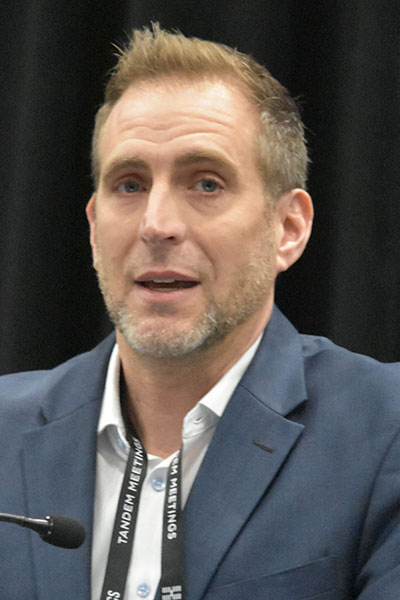
Dr. Eckrich, visiting associate professor at the University of Wisconsin School of Medicine and Public Health, Division of Hematology, Oncology, Transplant, and Cellular Therapy, began by summarizing important insights from recent studies on gene editing’s role in improving outcomes for pediatric patients with monogenic diseases such as sickle cell disease (SCD) and transfusion-dependent thalassemia. He also pointed to studies suggesting that exagamglogene autotemcel (exa-cel), a one-time, ex vivo CRISPR/Cas9 gene-edited autologous cell therapy, improved all measures of overall well-being and decreased pain experience for adults and adolescents over a multi-year follow-up period.
“We’re starting to enter the realm where, operationally, all of these monogenic disorders that kids suffer from are potentially curative with gene therapy or gene editing. It’s just a question of how we’re going to do these, how we’re going to execute on these trials,” Dr. Eckrich said.
He also pointed to a 2023 study that demonstrated, in three subjects, the proof-of-principle that gene-edited hematopoietic stem cells (HSCs) can engraft and alter fetal hemoglobin (HbF) by editing the HbF repressor. In this study, HbF as a percentage of total hemoglobin increased from 19% to 26.8%.
“For characterization, the best we ever achieve with hydroxyurea and handing out pills to kids is, maybe if we are lucky, we get their HbF up to 20%,” Dr. Eckrich explained. “So, by doing this [gene editing], manifestations of SCD decreased.”
Dr. Eckrich conveyed the advantages of autologous transplants over allogeneic transplants by spotlighting the limitations of the allogeneic method, which include the risk of graft failure, extended periods of immune recovery and the potential development of graft-versus-host disease. However, he also noted that there are important lessons that can be learned from allogeneic transplantation, such as aggressive management of hypertension, platelet transfusions during the thrombocytopenic period and infection prevention.
Regardless of the method, administering a genetically modified HSC product is a long, difficult multi-step process. One procedure that Dr. Eckrich highlighted was guiding autologous transplant patients through apheresis, the separation and collection of crucial components within blood. Apheresis can be a very frustrating portion of the therapy for patients. To support them, Dr. Eckrich noted that it’s best to limit collection attempts to as few as possible and to address all modifiable factors beforehand, including but not limited to supportive care. He also urged providers who care for these individuals to remain present throughout their journey.
“There’s one thing that you can do that will change the trajectory for some of these patients, and that is to stay with your patient for as long as you can,” Dr. Eckrich said.
He also sought to demystify apheresis for care teams, which can seem intimidating due to the burden on patients and the costly equipment required. Dr. Eckrich encouraged attendees to think of apheresis simply as “straws and a bucket.” In general, he said, slow and steady collection is best, and when in doubt, it’s okay to go deep into the layers, which are separated by density. Close monitoring of this process is also required.
“This is definitely not a ‘set-it-and-forget-it’ collection,” Dr. Eckrich explained. “You need to train people on what the expectations are around the timing it’s going to take, and the effort it’s going to take. You have to be very dynamic in apheresis.”
Reviewing keys to success for overall gene therapy programs, Dr. Eckrich asserted that successful treatment requires teams working together and planning in advance. More specifically, it can be beneficial to build relationships within the organization’s departments and to coordinate with reproductive endocrinology and pain/palliative care services. He also recommended planning for emergencies by developing ties with pediatric intensive care units.
“The key to success in some of this isn’t the manufacturer, it’s not the industry, it’s how well we care for our patients,” Dr. Eckrich said.