 Follow ASTCT®
Stella Davies, MBBS, PhD, MRCP, credits collaborative work as a key factor in her contributions to bone marrow transplantation research that have led to receiving the Mortimer M. Bortin Lecture Award at the 2026 Tandem Meetings | Transplantation & Cellular Therapy Meetings of ASTCT® and CIBMTR®.
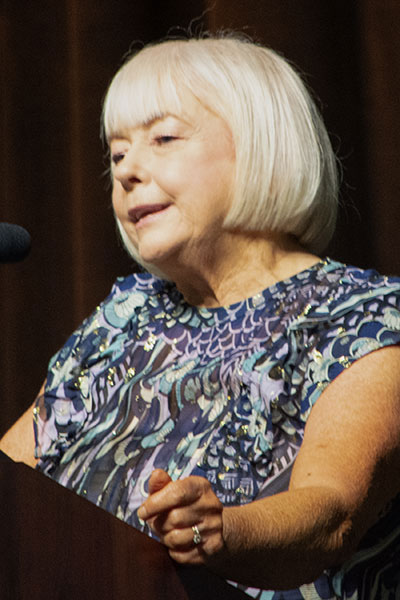
“The best things in life you do with a team of people, and bone marrow transplant is absolutely a team sport,” said Dr. Davies. “Nobody can do it alone, and nobody learns alone. Nobody advances the field alone. And that is splendid. I am so privileged to see how things have improved to the extent they have been in just my lifetime.”
Dr. Davies, professor of pediatrics and director of the Bone Marrow Transplant Program at Cincinnati Children’s Hospital, will deliver her Bortin Lecture, Waiting until Evening to See How Splendid the Day Has Been: Aging and Transplant at the Extremes of the Lifespan, at 5:10 p.m. MST Friday, Feb. 6, in Ballroom AB of the Salt Palace Convention Center. This lecture and other recorded sessions at the 2026 Tandem Meetings will be available for on-demand viewing following their live presentations through the online program.
The Bortin Lecture commemorates the founding scientific director of the precursor organization to the Center for International Blood and Marrow Transplant Research (CIBMTR), the International Bone Marrow Transplant Registry. Dr. Bortin is heralded for his instrumental role in the development of the CIBMTR as a global resource for hematopoietic cell transplantation research.
“As soon as the field opened, Dr. Bortin recognized that we needed to collect data, analyze data and work as a team,” Dr. Davies noted. “If you look at many other fields that have never had the same organization, they haven’t made the huge progress over the years that our field of bone marrow transplant has.”
Dr. Davies, who has run a National Institutes of Health (NIH)-funded translational studies laboratory for more than 25 years, credits Dr. Bortin’s foresight and the CIBMTR’s ongoing organization of data with enabling the monumental progress that has been realized in bone marrow transplant over the last half-century, including her own pioneering work to improve transplant survival rates and reduce toxicity.
“I learned an incredible amount from the staff members, faculty — everybody associated with CIBMTR — especially when I was young. I learned a lot of important facts, like statistics and how to analyze data, but what I really observed and have used subsequently, probably every day of my life, is how to organize a huge crowd of people,” she said. “CIBMTR receives a ton of data from all around the world with a ton of people who all have an opinion about what we should do with it, and they’re incredibly good at finding the meaning of it all.”
Dr. Davies has chaired the CIBMTR Advisory Committee and the CIBMTR Pediatric Cancer Working Committee. She is also a past president of the American Society of Transplantation and Cellular Therapy (ASTCT, 2021-2022). She has authored more than 500 peer-reviewed papers and currently holds four NIH-funded grants.
After 40 years on the job, she is not looking toward the finish line anytime soon.
“I’m not done yet, and when I look back, it has been absolutely splendid because when I started, things were just beginning in bone marrow transplant, first in small children, and it was hard, hard, hard,” Dr. Davies said. “It’s gotten much easier through group learning and sharing.”
Bone marrow transplant has not always been her career focus. Early on, Dr. Davies was an internist caring for adult patients. After about five years of clinical practice, she switched to pediatrics. And then, a job opened up in bone marrow transplantation and she found her professional home.
“I’m awestruck by the whole clinical procedure of bone marrow transplantation,” she said. “It’s a remarkable thing. The science is beautiful. The immune system is beautiful. And we still have so much more to unravel.”
Dr. Davies continues to work toward solving the puzzle of why children tolerate bone marrow transplant better and have higher survival rates than adults, a theme she plans to detail in her Bortin Lecture.
“I’m looking at learnings from children that can help us improve outcomes in adults,” she said. “I’m interested in why that difference is there and whether we can make adults more like children.”
Her optimism about finding answers is fueled, in part, by the unique camaraderie within the field.
“We’re accustomed to pulling our data to all learn together, and I love that,” Dr. Davies said. “We’re working with a bunch of friends, and we find out exciting things together.”
Watch 2026 Tandem Meetings sessions on demand

If you missed a session or wish to review a session from the 2026 Tandem Meetings, you can access on-demand recordings on the Tandem Meetings website. Registered participants have digital access to scientific plenary and concurrent sessions, oral abstract sessions, honorific lectures, symposia and educational tracks.