 Follow ASTCT®
Approximately three years ago, the Blood & Marrow Transplant Clinical Trial Network (BMT CTN) launched several initiatives aimed at increasing patient access to transplant clinical trials, particularly for underrepresented groups.
On Feb. 4, speakers at the Access to Clinical Trials Projects session of the 2026 Tandem Meetings | Transplantation & Cellular Therapy Meetings of ASTCT® and CIBMTR® reviewed the progress of two related programs.
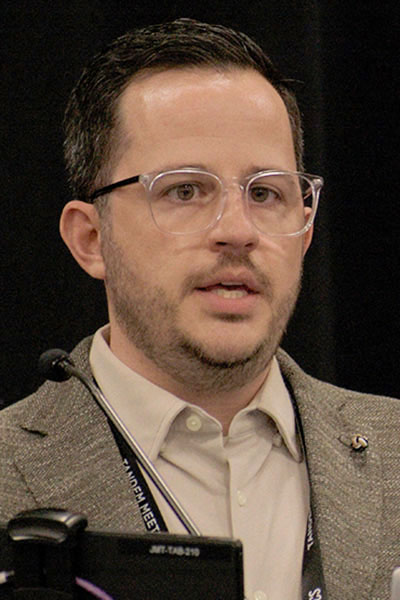
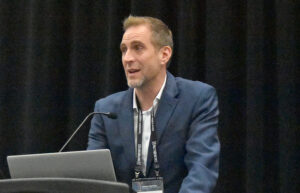
Ben Tweeten, MSW, LICSW, clinical social worker and manager of operations in the Patient Support Center at NMDP, provided an overview of Proactive Financial Navigation — a program designed to reduce financial burdens on patients diagnosed with severe aplastic anemia (AA).
Tweeten outlined the inherent financial vulnerabilities that these patients face.
“Over 75% of cancer patients report serious financial distress within the first year of their diagnosis,” Tweeten said.
He added that because of the high out-of-pocket costs associated with BMT, survivors can experience financial hardship even with insurance coverage. Furthermore, patients being treated for non-malignant disorders, such as AA, experience additional layers of financial hardship because many existing resources do not support patients with non-malignant diagnoses.
Proactive Financial Navigation builds on existing NMDP structures to work with patients who have been screened for the BMT CTN CureAA, 2207 trial and are seeking BMT therapy. At no cost to patients, the program matches each patient with a trained navigator who complements existing social worker services by learning from the patient about the barriers they are experiencing and then connecting them to financial resources.
Tweeten noted that the program is accepting additional patients and urged centers to screen potential 2207 candidates for their interest in participation. He said the program offers bilingual Spanish/English navigators and access to translator services for patients who speak other languages.
The program is soliciting ideas on improving services and reducing barriers to referring patients to the project. Tweeten asked centers to send questions or feedback by contacting the program at [email protected] or by using a QR code provided to the audience and accessible to digital attendees who view this session on demand.
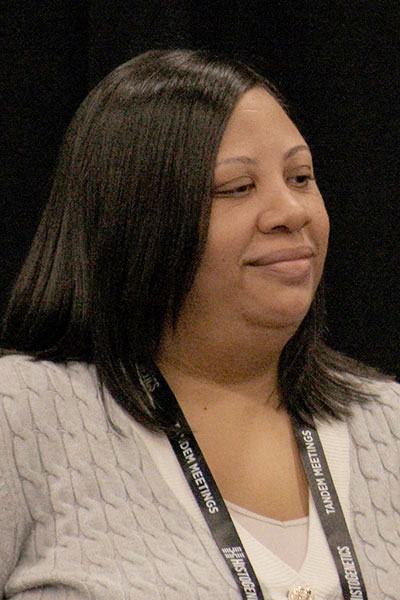
Other NMDP resources to assist centers in supporting patients can be found on the NMDP website.
Rayne Rouce, MD, associate professor of pediatrics at Texas Children’s and Baylor College of Medicine, and Mohamed Sorror, MD, MSc, professor of clinical research at Fred Hutchinson Cancer Center in Seattle, detailed a pilot multimodal educational program designed for patients eligible for participation in two high-priority BMT CTN trials, the CureAA, 2207 trial in patients with severe anaplastic anemia and the BMT CTN 2203 GVHD Prophy-Rux (PROGRESS IV) trial that will assess the utility of adding ruxolitinib to medications commonly used to treat patients with graft-versus-host disease (GVHD).
Several groups guided the creation of the short informational videos that are a part of the outreach: a focus group of BMT CTN investigators, referring providers, patients, caregivers and the BMT CTN Patient Caregiver Advisory Council.
Most of the advisory patients and caregivers self-identified as racial or ethnic minorities, reflecting an intent to create material that speaks to under-represented populations in the United States. Drs. Rouce and Sorror explained that the recommendations from the advisory group members helped shape culturally sensitive and visually appealing information that can address the spectrum of concerns patients may have around clinical trials.
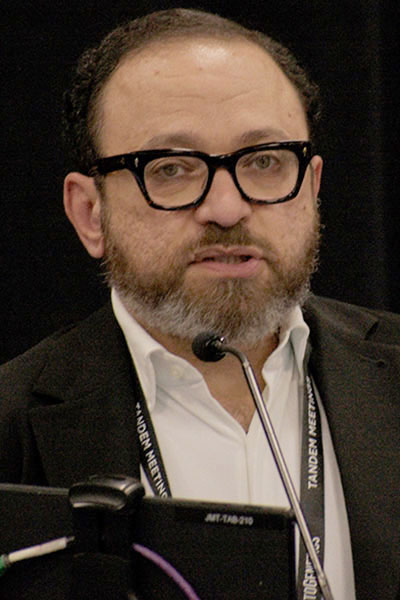
“Sometimes, it is not the clinical trial itself, or the study question itself, it is the general hesitancy to participate in clinical trials, particularly those that include an intervention,” Dr. Rouce said.
The first print and video educational modules for the two clinical trials are expected to be ready — with both English and Spanish language versions — for distribution in spring 2026, but the core of the material, with its general focus on addressing culturally relevant information about BMT CTN clinical trials in general, is designed to apply toward future studies as well.
“Implementation and how we are going to use these tools are important,” Dr. Sorror explained. “We thought there could be different ways that we could use them in the clinic and could be built into the workflow of these two trials, or other clinical trials in the future.”
Dr. Sorror reviewed some of the different approaches for implementing the multimodal educational content, such as a randomized patient recruitment sequence, an embedded pragmatic evaluation or a hybrid approach, and how these options could be adapted to be minimally disruptive to the workflow at participating transplant centers.
Across the different implementation approaches, the impact of multimodal education can be assessed by tracking a patient’s willingness to review the consent form, the overall consent rate and the time it takes from the first approach to when the patient decides about participation.
“[This information] can also help us evolve ways in which we approach our patients for trials to achieve higher access,” Dr. Sorror said. “Outcomes will be brief post-encounter surveys introduced after enrollment assessing comprehension, trust, perceived relevance and satisfaction with the decision-making process.”
Watch 2026 Tandem Meetings sessions on demand

If you missed a session or wish to review a session from the 2026 Tandem Meetings, you can access on-demand recordings on the Tandem Meetings website. Registered participants have digital access to scientific plenary and concurrent sessions, oral abstract sessions, honorific lectures, symposia and educational tracks.